
Hybrid Campaigns vs. Traditional Production: What Changes When AI Enters the Process?

Updated: Aug 29
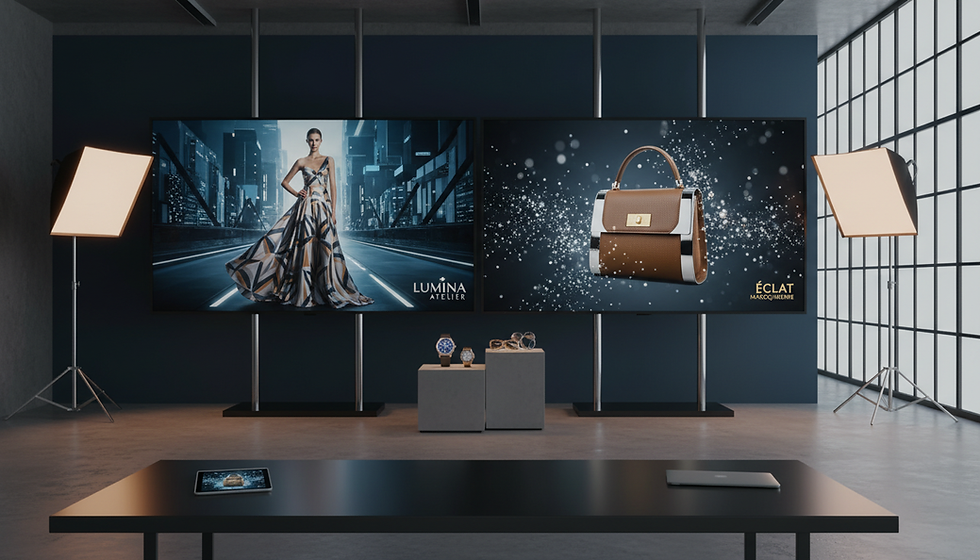
The rise of AI-generated campaigns has introduced a new production model: the hybrid campaign. Instead of replacing traditional photography and film, hybrid production combines real talent, physical shoots and AI-driven content generation into one integrated workflow. The result is not a compromise between two worlds, but a structural shift in how campaigns are developed, produced and scaled.

What Is a Traditional Campaign Production?
Traditional campaign production is built around physical presence. Teams travel, sets are constructed, lighting is installed, talent is booked, and the final output depends on what can be captured within a limited timeframe.
This model delivers authenticity, human nuance and tangible atmosphere. However, it is also bound by:
Fixed shooting days
Location constraints
High logistical costs
Limited post-shoot flexibility
Once a shoot is finished, expanding or adjusting the campaign often requires additional production days.
What Is a Hybrid Campaign?
A hybrid campaign combines real-world production with AI-assisted creation. Real models, photographers and creative directors remain central. AI tools are integrated before, during or after the shoot to expand visual possibilities, optimize variations and scale outputs efficiently.
In a hybrid workflow, AI may be used to:
Generate additional environments
Adapt lighting or seasonal moods
Create alternative backgrounds
Extend campaign formats across markets
Produce motion from still images
Instead of reshooting, brands can iterate digitally.
Creative Control Does Not Disappear
One of the most common misconceptions about AI-generated campaigns is that automation replaces creative direction. In reality, hybrid campaigns demand even more conceptual clarity.
AI does not invent brand strategy. It interprets inputs.
The quality of a hybrid campaign depends on:
Clear art direction
Strong visual identity
Precise briefing
Professional post-production oversight
Human creativity remains the core. AI extends execution.
Efficiency and Scalability
Traditional production delivers powerful hero assets. Hybrid production adds adaptability.
For example, a fashion campaign shot with real talent can be expanded into:
Multiple seasonal variants
Localized market versions
Social-first formats
Motion adaptations
Product-focused detail visuals
Without additional full-scale production days.
This scalability is one of the main reasons brands explore AI-driven campaign models.
Cost Structure: Different, Not Cheaper by Default
Hybrid production is not automatically “low-cost.” It shifts cost allocation.
Traditional production invests heavily in logistics, travel, equipment and location.Hybrid campaigns shift part of that investment toward:
AI design specialists
Prompt engineering
Advanced post-production
Digital asset pipelines
The value lies in long-term content infrastructure rather than a single hero shoot.
Where Traditional Production Still Wins
There are scenarios where purely traditional production remains preferable:
Documentary-style authenticity
Complex physical interaction
High-risk materials (e.g. transparent fabrics, reflective surfaces)
Situations requiring absolute tactile realism
Hybrid production works best when brands want flexibility without losing real human presence.
Strategic Use Cases for Hybrid Campaigns
Hybrid models are particularly effective for:
Fashion and luxury brands
Global roll-outs across markets
E-commerce scaling
Multi-platform campaign systems
Brands experimenting with AI-generated marketing content
The model is not about replacing reality. It is about expanding creative range.
The Structural Shift
The key difference between traditional and hybrid campaigns is not aesthetic. It is structural.
Traditional production ends when the shoot ends.Hybrid production continues beyond the shoot.
Campaigns become modular systems rather than static outputs.
For modern brands operating in fast content cycles, this shift is strategic rather than experimental.
In conclusion, hybrid campaigns redefine production workflows by combining real talent with AI-generated campaign expansion. The future is not human versus machine. It is structured collaboration between both.
The shoot does not disappear. It becomes the most important day of the campaign.
Frequently Asked Questions
What actually changes between hybrid and traditional production?
The structure. Traditional production repeats itself per asset; hybrid production concentrates effort into one capture and derives everything else from it.
Are there still shoot days?
Yes, usually fewer and more carefully planned. The shoot has to serve the whole asset list rather than a single set of images.
What happens to hero assets?
They remain photographed. Hero images carry the campaign's claim and are the least suitable candidates for generation.
Where does motion fit in?
Increasingly the same logic applies: capture the real material, extend it into formats and versions. The tolerance for generated motion is still lower than for stills.
Is the structural shift permanent?
It looks so. Once variation is cheap, campaigns are planned around it, and that changes the brief rather than only the production.
About The Bridges AI
The Bridges AI is an independent AI and hybrid campaign production company working in strategic partnership with Most Wanted Models®, the German model agency founded in 1997 and a member of VELMA. Combining nearly 30 years of fashion, talent and campaign expertise with generative AI, The Bridges AI produces high-end imagery and video for fashion, beauty and premium brands worldwide.


Comments