
The Role of AI-Generated Advertising Visuals in Modern Campaign Production

Updated: Aug 29
The advertising landscape for fashion, luxury, and premium brands is evolving rapidly. Visual campaign production now integrates advanced technologies to meet the demands of speed, scalability, and creative precision. Among these technologies, AI-generated advertising visuals have emerged as a critical component in hybrid campaign production models. These models combine traditional creative expertise with AI capabilities to deliver high-end advertising visuals that maintain brand integrity while optimizing production workflows.
This article explores the strategic role of AI-generated advertising visuals in contemporary fashion campaign production. It highlights how hybrid AI campaign production enhances creative control, visual consistency, and production efficiency. The discussion is grounded in practical applications relevant to international fashion and luxury brands, creative agencies, and brand teams seeking scalable, premium visual content.
The Evolution of Visual Campaign Production in Fashion and Luxury Brands
Visual campaign production for premium brands has traditionally relied on extensive photo shoots, involving real talent, physical products, and elaborate sets. This approach ensures authenticity and brand alignment but often comes with high costs, logistical challenges, and limited flexibility.
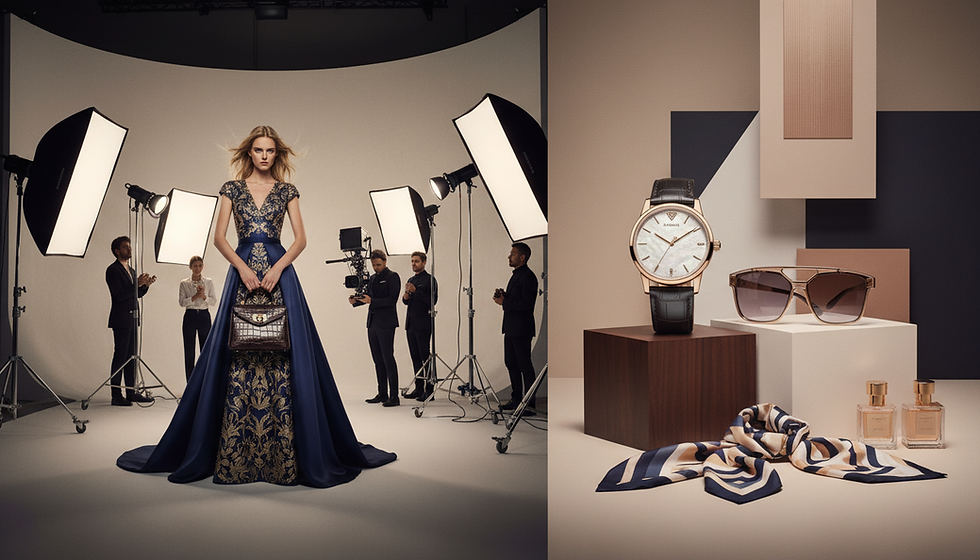
The introduction of AI into campaign production has not replaced these traditional methods but has supplemented them, creating hybrid AI campaign production workflows. These workflows leverage AI-generated campaign imagery to complement real photography, enabling brands to:
Accelerate production timelines by generating multiple visual variations quickly.
Maintain creative control through precise direction of AI outputs.
Scale visual content without proportionally increasing production costs.
Ensure visual consistency across diverse campaign assets.
This hybrid approach respects the craftsmanship of traditional production while integrating AI as a professional tool to enhance output quality and efficiency.

Strategic Advantages of AI-Generated Advertising Visuals
AI-generated advertising visuals offer several strategic advantages in the context of fashion and luxury brand campaigns:
1. Enhanced Creative Flexibility
AI tools can generate multiple iterations of a visual concept based on specific creative briefs. This flexibility allows creative directors to experiment with styles, backgrounds, lighting, and compositions without the constraints of physical shoots. For example, a single product can be visualized in various settings or with different color schemes, enabling rapid exploration of creative directions.
2. Cost and Time Efficiency
Producing high-quality visuals traditionally requires significant investment in talent, locations, and post-production. AI-generated imagery reduces the need for extensive reshoots and location changes, cutting down both time and budget. This efficiency is particularly valuable for seasonal campaigns or rapid product launches where time-to-market is critical.
3. Consistency Across Campaign Assets
Maintaining visual consistency is paramount for brand recognition. AI-generated visuals can be programmed to adhere to strict brand guidelines, ensuring uniformity in color palettes, lighting, and styling across all campaign materials. This consistency supports cohesive storytelling and strengthens brand identity.
4. Scalability for Global Campaigns
International campaigns often require localized visuals tailored to different markets. AI-generated advertising visuals enable scalable production of region-specific content without the need for multiple physical shoots. This capability supports global brand strategies while respecting local nuances.

Integrating Hybrid AI Campaign Production into Visual Workflows
The Bridges focuses on hybrid AI campaign production for fashion and premium brands, combining real talent, real products, and AI-generated visuals to optimize campaign outcomes. This integration involves several key steps:
Pre-Production Planning
Creative Briefing: Define the campaign’s visual objectives, brand guidelines, and desired outputs.
Asset Collection: Gather high-quality images of products and talent for AI training and reference.
AI Model Selection: Choose AI tools capable of generating visuals aligned with the brand’s aesthetic.
Production Execution
Hybrid Shoot: Conduct physical shoots for essential assets, capturing real talent and products.
AI Generation: Use AI to create supplementary visuals, variations, or backgrounds based on the shoot.
Creative Direction: Maintain oversight to ensure AI outputs meet creative standards and brand requirements.
Post-Production and Delivery
Refinement: Edit and retouch AI-generated images to enhance realism and polish.
Quality Control: Verify visual consistency and adherence to campaign goals.
Distribution: Prepare final assets for multi-channel deployment, including digital, print, and social media.
This workflow exemplifies how hybrid campaign production balances human creativity with AI efficiency, delivering premium advertising visuals that meet the complex demands of modern fashion campaigns.
Practical Applications and Use Cases in Fashion Campaign Production
Several practical applications demonstrate the value of AI-generated advertising visuals within hybrid production models:
Product Variations: AI can generate images of a product in different colors, textures, or configurations without additional physical samples.
Virtual Styling: AI enables virtual styling of models with various outfits and accessories, reducing the need for multiple wardrobe changes during shoots.
Background Replacement: AI-generated backgrounds can replace or enhance physical sets, offering diverse environments without location costs.
Rapid Prototyping: Brands can visualize campaign concepts early in the process, facilitating faster decision-making and iteration.
These use cases illustrate how AI-generated visuals support creative experimentation and operational efficiency, essential for premium brand campaigns that demand both innovation and precision.
Future Outlook: AI Advertising Production as a Professional Tool
The role of AI in advertising visuals is evolving from a novelty to a professional production tool. Hybrid campaign production models demonstrate that AI is not a replacement for human creativity but a complementary asset that enhances production capabilities.
The Bridges focuses on hybrid AI campaign production for fashion and premium brands, emphasizing:
Creative direction: Ensuring AI outputs align with brand vision and campaign objectives.
Production expertise: Integrating AI seamlessly into established workflows.
Brand sensitivity: Maintaining the authenticity and luxury appeal of premium brands.
Industry understanding: Applying AI solutions that respect the nuances of fashion and advertising.
As AI technology advances, its integration into visual campaign production will deepen, offering brands greater control, scalability, and creative potential. The strategic use of AI-generated advertising visuals will continue to redefine how premium campaigns are conceived and executed.
This analysis underscores the importance of adopting hybrid AI campaign production to meet the evolving demands of fashion and luxury brand advertising. By combining real talent, real products, and AI-generated visuals, brands can achieve superior creative outcomes with enhanced efficiency and consistency.
Virtual sets removed the location scout. They did not remove the need for art direction.
Frequently Asked Questions
What are virtual styling and virtual sets?
Generated environments and styling context built around photographed subjects, replacing location shoots and set construction for assets where the setting is contextual.
When is a real location still necessary?
When the location itself is part of the story, or when the campaign makes a claim about a place. Otherwise it is a cost without a corresponding message.
How many settings can one shoot support?
Effectively unlimited, provided the capture was lit and framed with that flexibility in mind. Fixed, heavily location-matched lighting narrows the options.
What has to be planned at the shoot?
Neutral, controllable lighting and enough framing latitude. Both are decisions that cannot be made afterwards.
Does this change how art direction works?
It moves more of it before the shoot. The environments are decided in advance because the capture has to suit them.
About The Bridges AI
The Bridges AI is an independent AI and hybrid campaign production company working in strategic partnership with Most Wanted Models®, the German model agency founded in 1997 and a member of VELMA. Combining nearly 30 years of fashion, talent and campaign expertise with generative AI, The Bridges AI produces high-end imagery and video for fashion, beauty and premium brands worldwide.


Comments